A post on the r/leftistpreppers subreddit caught my eye, as someone found their way into a bunch of very valuable "corny" (Cornelius) kegs due to their situation. They were curious if they were valuable for "water storage". Oh, boy, howdy…
I responded on that topic, then we moved to talking about preserving apple juice from a local harvest.
The following is a lightly edited version of my responses; I hope it helps folks. :)
[The kegs] are quite valuable, no one should be throwing away ~$100 stainless kegs.
I'm /assuming/ those are basically Cornelius ("corny") kegs with the usual ball-lock valves. If you take it to your Friendly Local Homebrew Shop, they'll be able to confirm on sight. :)
The link above, or this one, will take you to one of the major homebrew retailers, and they'll have "get started kegging!" kit like this.
Basically:
input CO₂
- CO₂ tank (5-10lbs; homebrew shop or welding supply; these are often done with a deposit on the tank itself and ~$30 for 10lbs of CO₂ on the swap)
- regulator: hundreds of psi on the tank side down to dozens on the keg side
- tubing into the ball-lock fitting
- fitting mates to the "in" port on the keg
- there's a little dip tube on the inside just into the headspace of the keg.
output liquid
- ball lock fitting to tubing on the "out" side
- this has is a long tube that stretches down to the lowest point at the inside center of the keg.
- start with a "picnic tap" like in that kit above, eventually upgrade to a proper draft system.
All that is – I'm fairly sure – identical to what they did for the nitro coffee, just CO₂ instead of N₂.
You want to let the water sit on tempature-appropriate pressure¹ for about a week to carbonate it. In my setup, I have the regulator output split into two, so one keg is dispensing while the other is "charging" with pressure so when the first keg kicks, I swap dispensing over, replace the empty, and the cycle continues.
¹ The ability of CO₂ to dissolve into a liquid is a function primarily of the temperature of the liquid. The colder the easier. So if you have your liquid at fridge temps (35-40°F), 15psi is fine, but at basement temps (see below; 50-60°F, depending on season), I usually run it at like 35-40psi.
With 8 kegs, I have 8 kegs × 19 L/keg = 152L / 2 (on average) = 75L of water available at any given point, and it can be dispensed by CO₂ pressure, even if power is out. Could be used for most any purpose, even while carboated: cooking, cleaning, filling toilet tanks, &c. And I could be more aggressive about keeping the empties filled if I know a storm is coming or something. (I also generally have 2 of everything, so a spare CO₂ tank is waiting in the wings for when the active primary gets empty.)
One thing people do is take a chest freezer, remove the lid, build a wood collar that just rests on top of the freezer, re-attach the lid to the collar, and drill holes for the draft taps through the collar. You then get an external temperature controller that drives the freezer as a fridge, instead.
This does tend to kill the compressor on chest freezers, ime (I'm on my 3rd over 15 years), so these days I just keep it at basement temps, fill spare 1L bottles, and keep them in the normal/kitchen fridge for our daily-drinking needs.
(I would really like to move a subset of the setup into the kitchen, under-counter, so we could just have a proper draft tower dispensing carbonated water, next to the sink. ;)
Thus: properly cold draft carbonated water, at scale, for pennies (amortized over years, of course :), without all the waste, overhead, and faffery of something like a SodaStream.
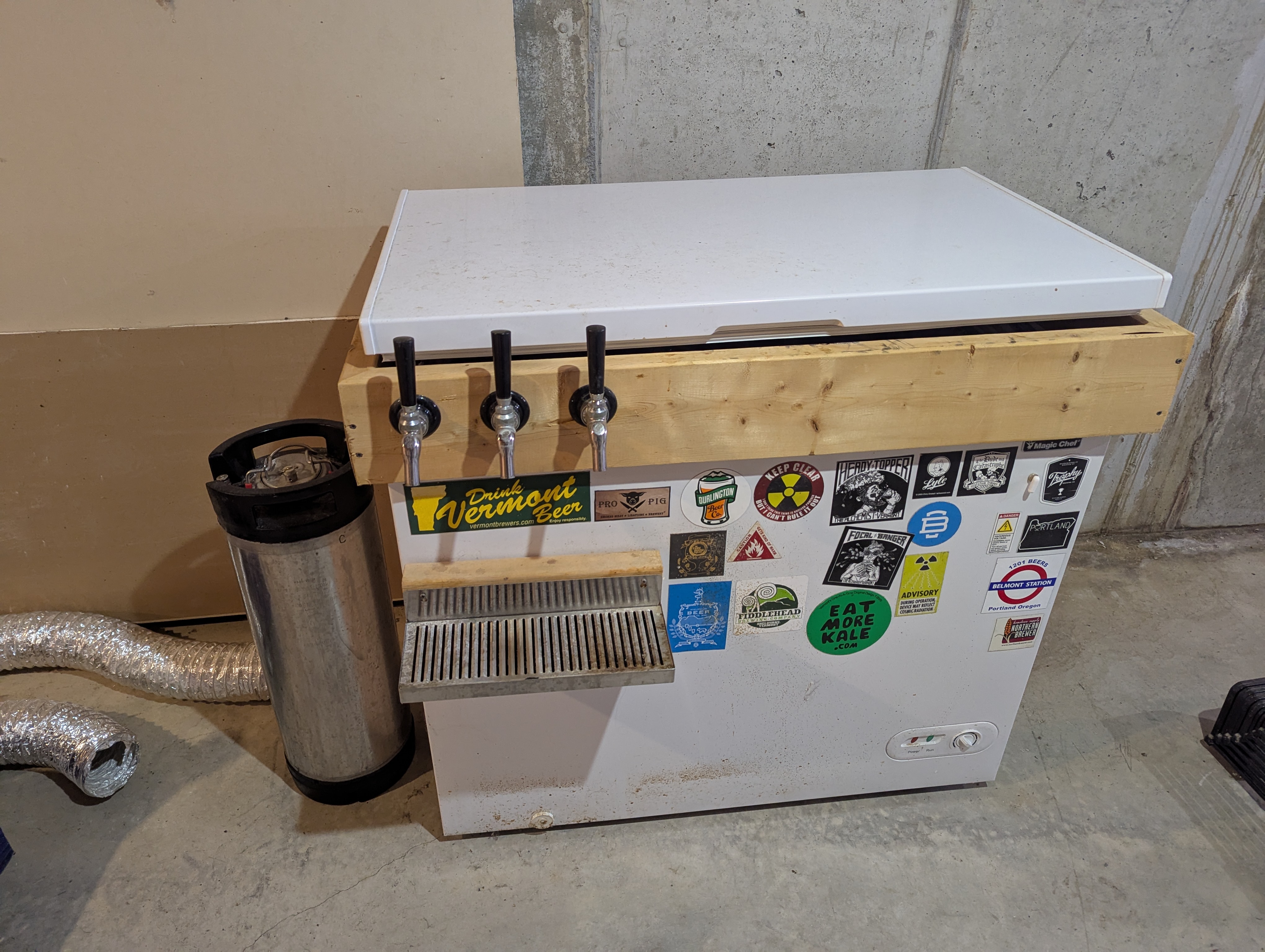
- kegerator exterior — here you can see the "collar" I talked about, with draft taps; note the keg to the left … that's carbonated apple cider from this year's harvest from our field. :)
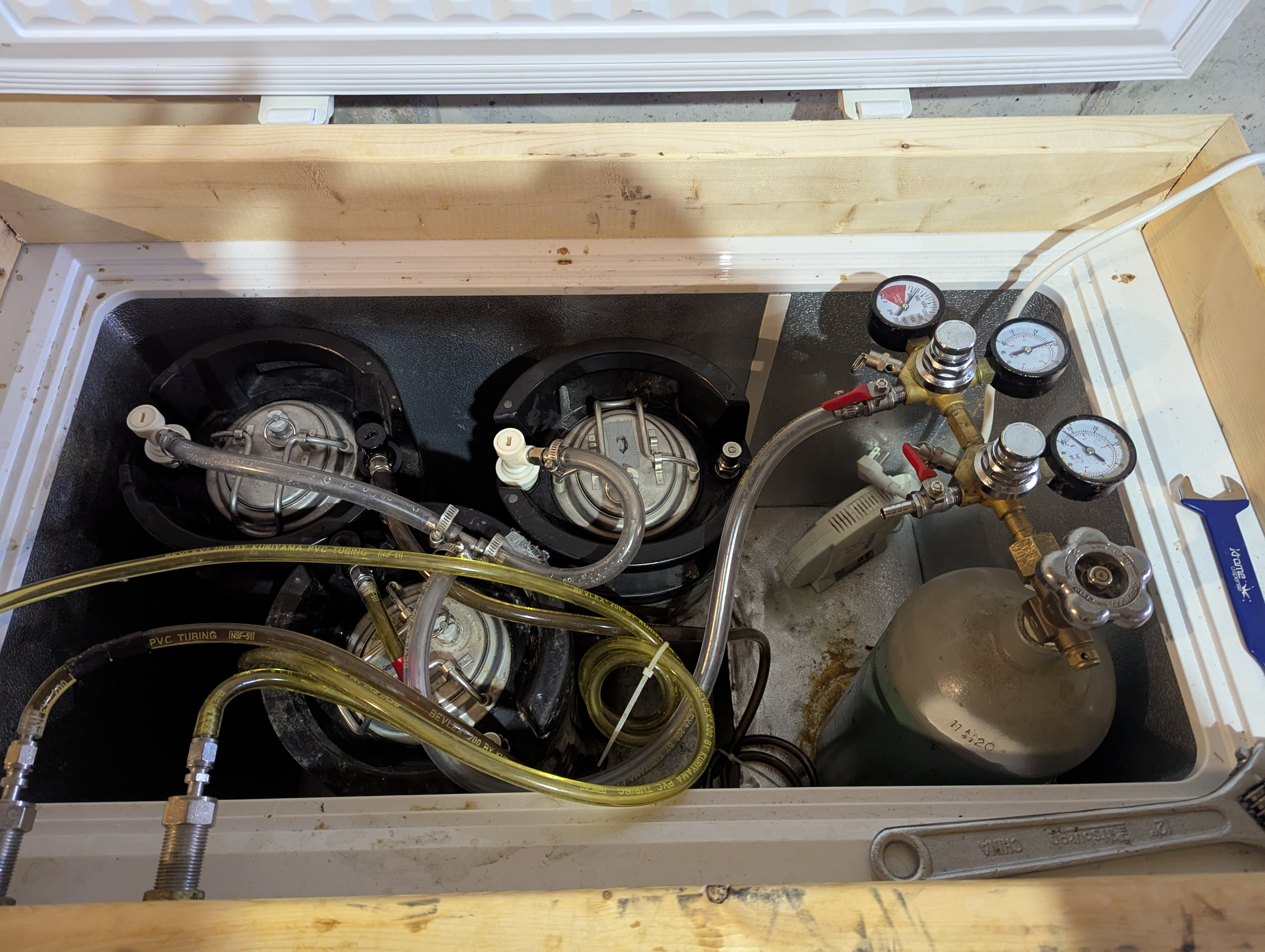
- kegerator interior — here you can see the interior: 3 kegs, regulator with the split line. I honestly don't know what's in the 3rd middle keg, lol.
- regulator detail — fairly fresh tank, 700psi on the high side, 29 psi on the low side
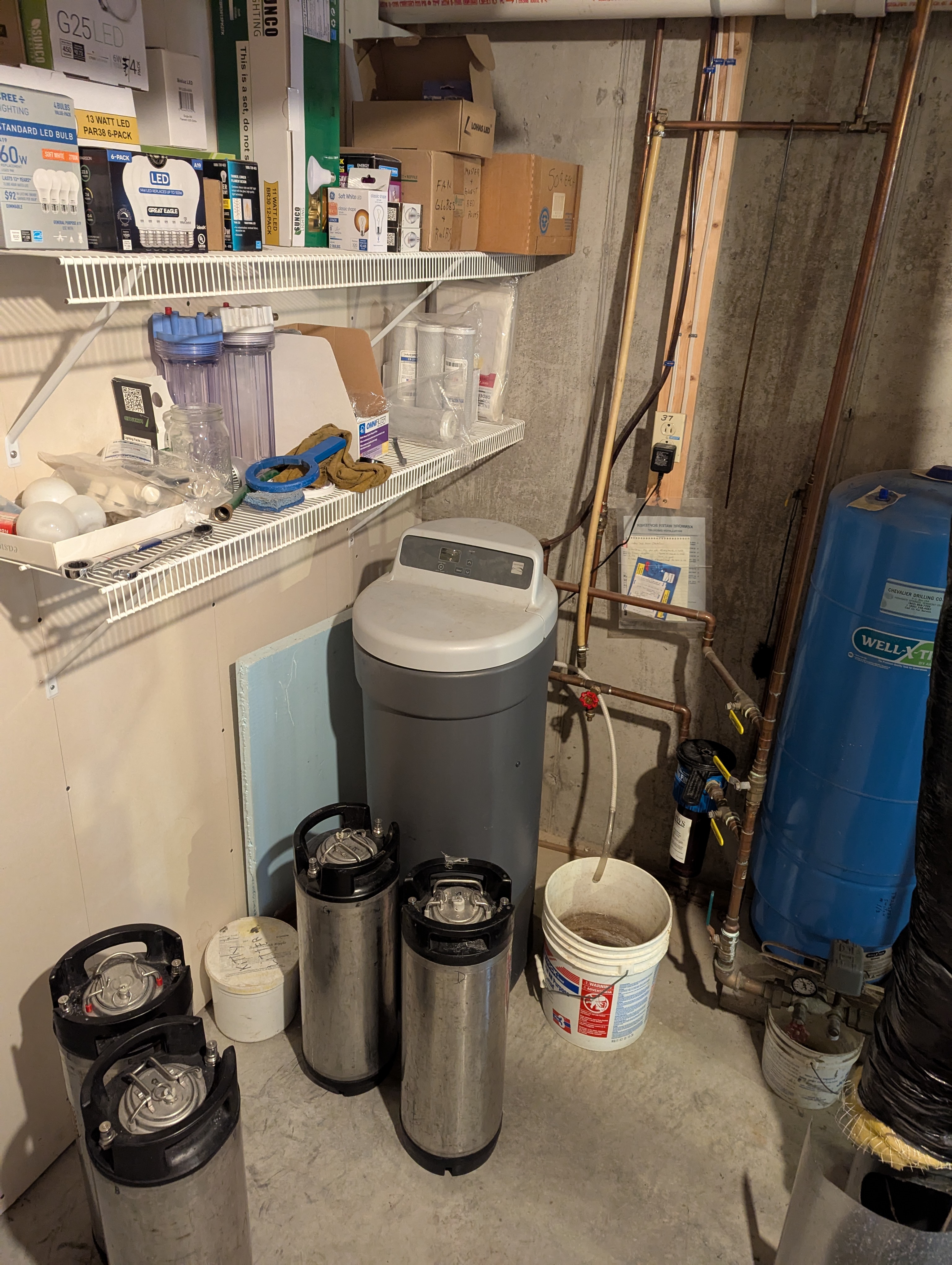
- spare kegs, next to the water supply — these are the full/empties; note the light-brown line hanging off the copper piping … that fits into a ball-lock fitting off the red-handle spigot, that I use to fill the kegs … more re-purposed homebrewing stuff
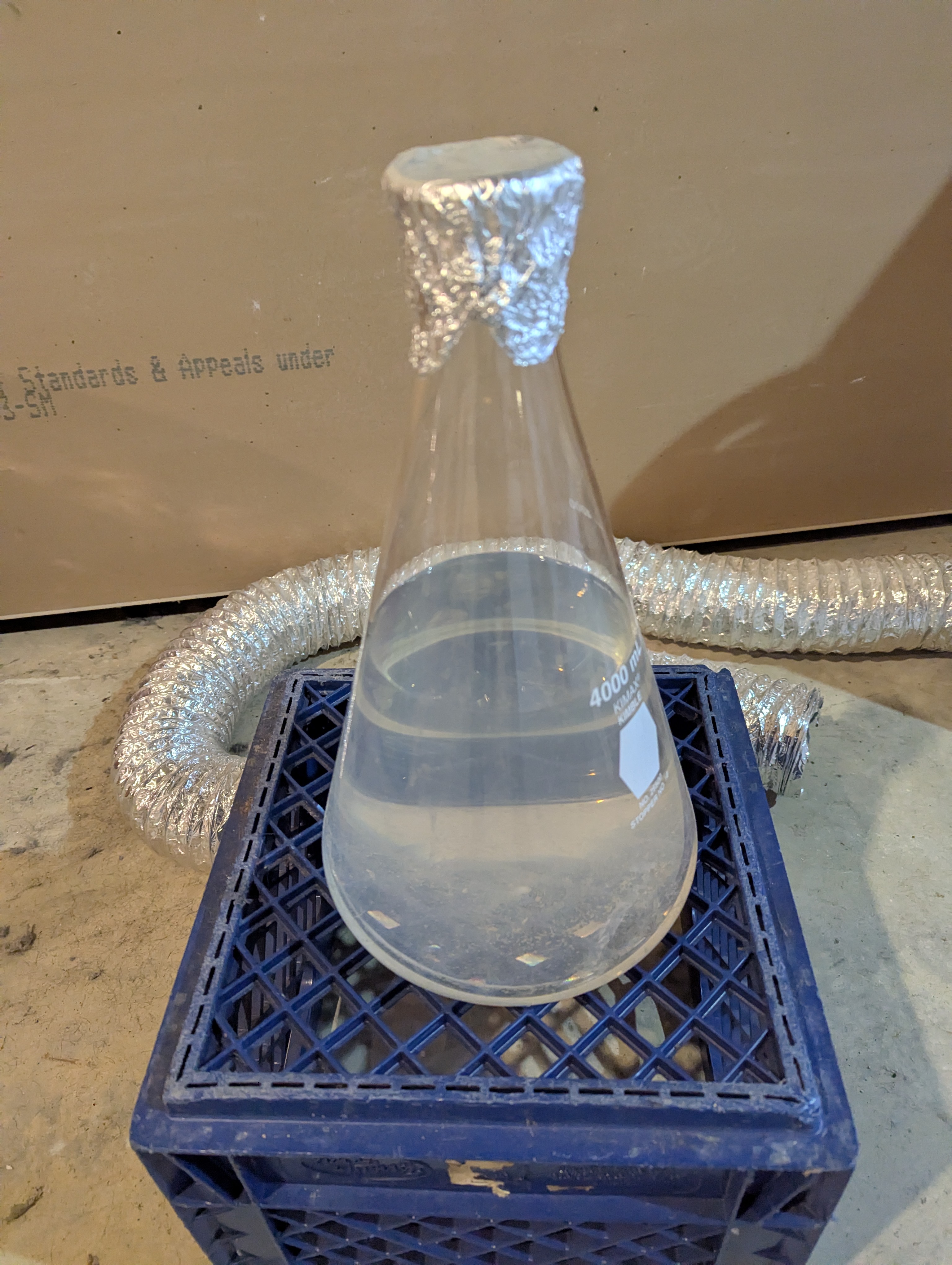
- starsan — some spare liters of starsan; most recently used to sanitize carboys for the apple(-juice) harvest, but it's stable to be re-used for a long time at a time…

(There was an inquiry here about the incidental "note the keg to the left … that's carbonated apple cider from this year's harvest from our field. :)" line…)
So, there's three parts to harvesting apples for juice:
- you "scrat" the apples into chunks
- you press the chunks into juice
- you preserve the juice
There's lots of options for scratting, but I use (clean, otherwise unused) garbage disposals to turn apple meat into bits - scratters
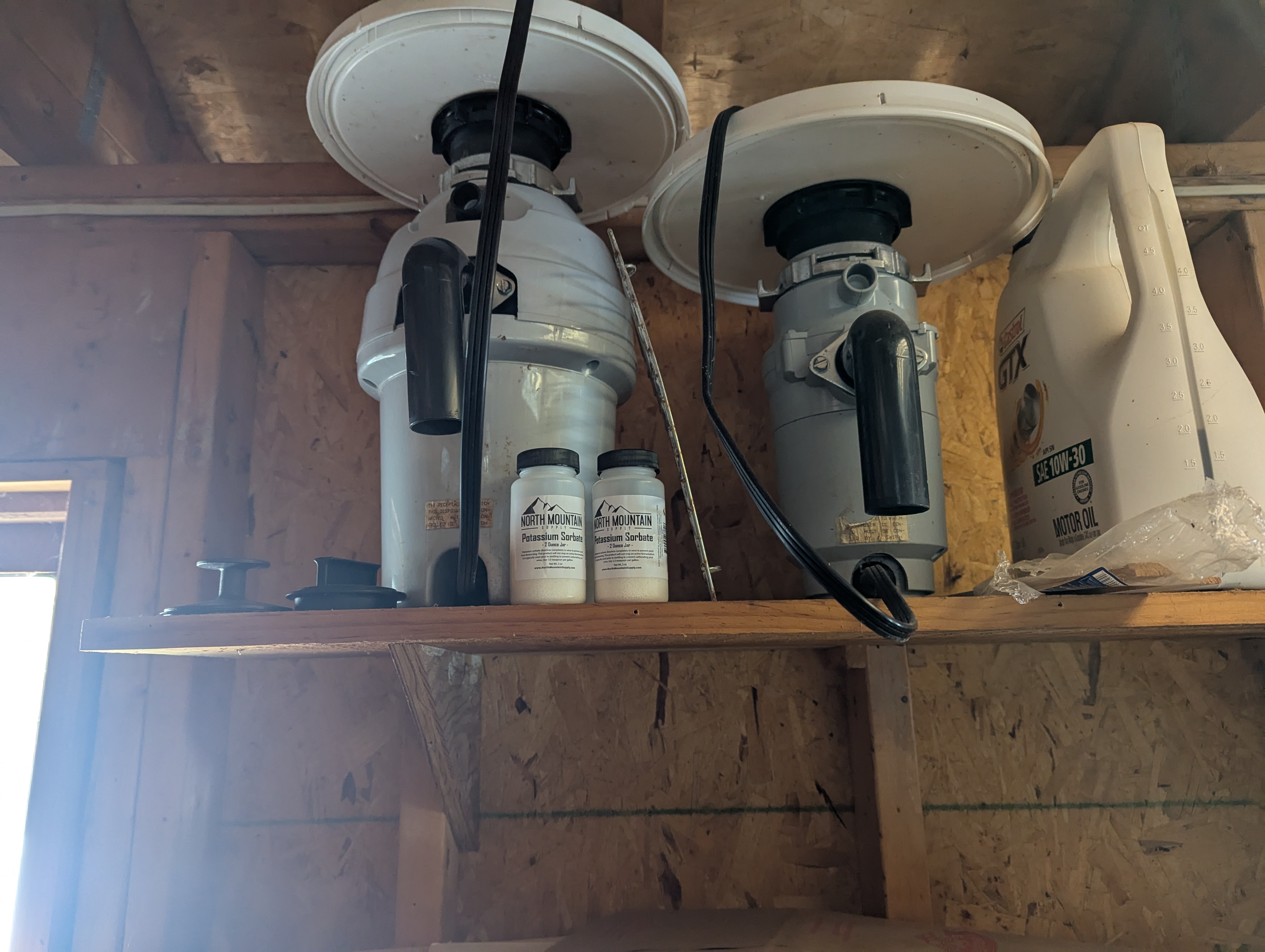
This uses tons of buckets: to stand the scratters, on top, and then to collect the resultant pulp. - buckets

Lids for those buckets have quarter-arc cut-outs so the scratter sitting on top can output into a collection bucket. Lots of buckets.
Note that there /is/ a preparation step. We sit in the garage with cutting boards, chopping apples into at /least/ quarters, and manually feeding them into the disposals. It's laborious.
Then you have a pulpy mix of apple and juice.
You feed it into a press. I … can't find mine to take a picture! But we have some Chinese-produced press like this. Manual screw drive. It takes some time, it's kinda messy … we do it just off the garage so I can soak the bits into the ground.
Once you collect the juice (and find of some way to share/dispose of the remanant pulp … you have a serious compost setup, right? XD maybe your equine-afile neighbor might want it? …), you collect the juice into buckets and/or carboys (again, another remnant of my homebrewing days I have many of).
You might notice in the earlier picture of the "scratter" garbage disposals a couple of canisters of "potassium metabisulfite" … "K-meta". This is a sulfite well-used throughout wine and cider making … it basically kills all the bad stuff, rendering the must inert from whatever ambient yeast, bacteria, whatever what was on the skins of the apples. This is a very rough process, up until this point. If you are sulfite-sensitive, find other options (I can't speak to those).
So now you have gallons of "inert" apple juice. Now you need to preserve it.
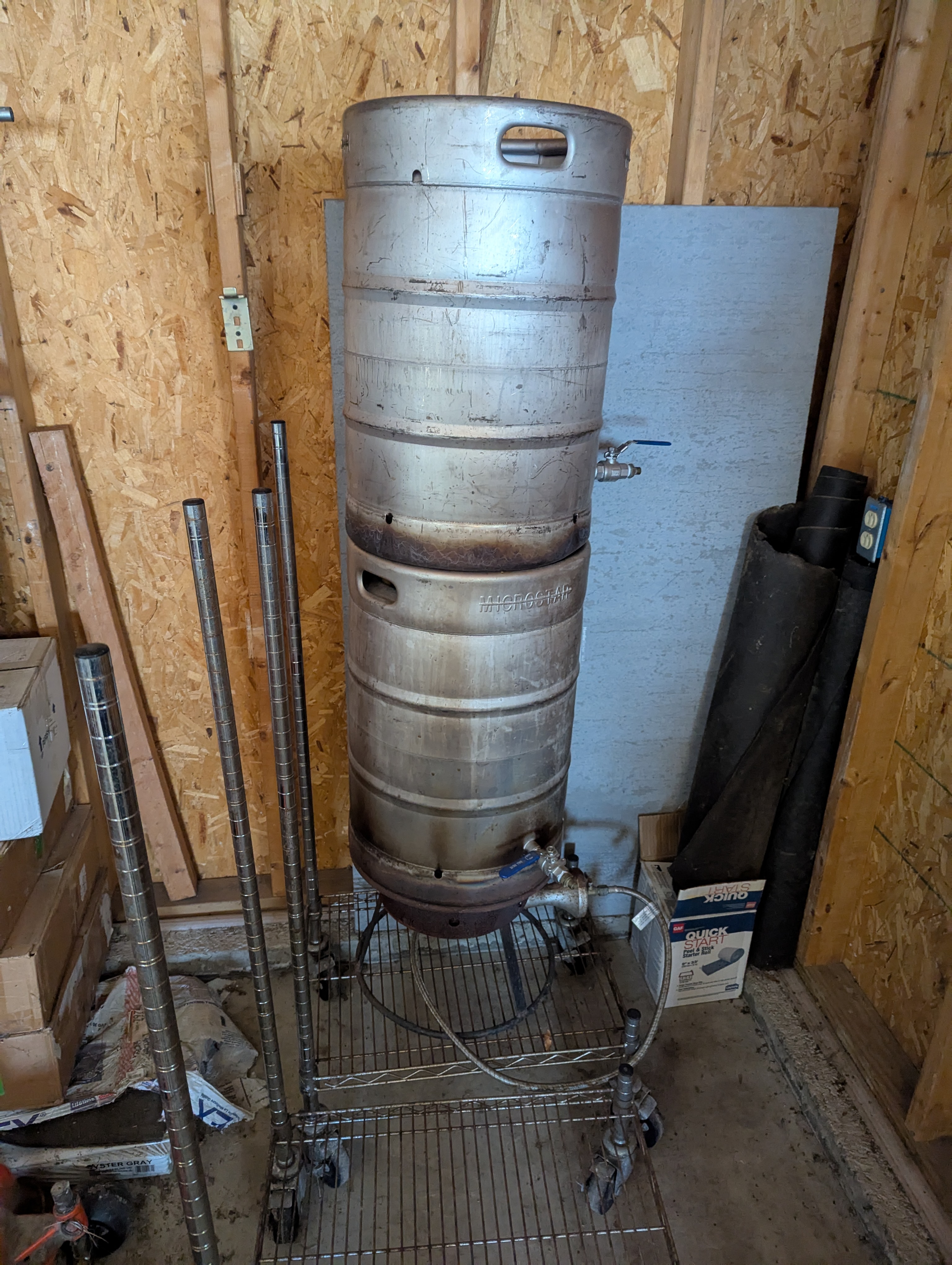
You'll want to siphon it into jars … we use half-gallon mason jars. They're big. So you might want to use your previous homebrewing kit (you have this, right? ;) to do an appropriate "boiling water bath" canning process, where you submerge the mason jars, lidded, under water and boil them for 10-15 minutes … that's where my old homebrewing keggle comes in…
(BTW…
Heat quickly, stirring occasionally, until juice begins to boil. Fill immediately into sterile pint or quart jars or fill into clean half-gallon jars,
Fuck this. Just get reasonably-strained juice into jars. You don't need to pre-boil it. It's important that you don't have apple chunks in there, but if you're getting clean juice, you can just proceeed directly to canning.)
That's two stacked "keggles", for winter storage, with the big-ass cajun burner underneath. I only use the burner and one of the keggles for canning, at a time; the other is just extra. Maybe a 20lb propane tank each year…
Those jars get boiled underwater, then pulled out, cooled, and put in our stores.
We have something like 200gl of apple juice in the basement. That's across 2 years … 2-3 front-end-loaders's worth of apples from our … 2 really productive trees (and a bit from the other less-productive ones), each year. Our harvest is basically "every other year" … though a couple of years ago the Vermont apple crop was fucked by a late-spring frost that killed all the buds, so … so it goes. :)
Each year, it takes a good long week of finding time in the mornings and after work, that is the focus, to "get the apple harvest in".
We've tried canning apple slices … and chunks … and dehydrating slices and vaccuum-sealing them. Juice is the best bang for our buck in terms of long-term value-extraction, but ymmv.